Boiler Feed Pump Calculation: Sizing, Head, BHP & NEMA Motor
Perform an accurate boiler feed pump calculation to determine required design flow rate (GPM or m³/hr), Total Dynamic Head (TDH), shaft power, and standard commercial NEMA/IEC motor sizing under ASME Section I guidelines.
Boiler Feed Pump Sizing Calculator
Enter your boiler operating specs below to calculate required flow capacity, dynamic head, shaft mechanical demand, and recommended commercial NEMA motor sizing.
Steam Capacity & Feedwater Flow
Continuous maximum rating (1 BHP = 34.5 lb/hr steam at 212°F / 100°C).
Percent of steam output purged for TDS control (typically 3% to 5%).
ASME standard allowance (15% to 20%) to recover water level during sudden draws.
Deaerator liquid temperature (auto-derives SG from steam tables).
Pressures & System Resistance
Internal operating gauge pressure inside the steam drum.
Drop across check valves, feed modulating valve, economizer, and pipes.
Boiler water inlet centerline above pump centerline.
Positive pressure available at pump suction (assists pump discharge).
Pump Efficiency & NEMA / IEC Motor Specs
Multistage centrifugal impeller efficiency (typically 60% to 75%).
Engineering power cushion added before selecting commercial motor frame.
Feed Tank Storage
Usable reserve at boiler MCR (typically 10 to 20 minutes). Blank uses 15 min.
Verify that available suction head (NPSHa) prevents cavitation. When boiling deaerator water flashes to vapor, severe pitting and impeller destruction occur.
Vertical distance from deaerator water line down to pump inlet centerline.
Head loss in suction pipe, isolation gate valve, and strainer.
Published by pump manufacturer at your design flow.
ASME standard: 3 to 5 feet (1 to 1.5 m) buffer above NPSHr.
Convert discharge pressures into column height (feet or meters of head) corrected for water temperature and thermal density expansion.
Enter pressure or physical column height.
Sets water density specific gravity from steam tables.
How to Use Boiler Feed Pump Calculator Step-by-Step
Follow these straightforward steps to enter your plant data into the calculator and size your feedwater pump accurately:
Step 1: Select Your Measurement Standard
Pick US Customary (GPM, psi, feet, BHP) or Metric SI (m³/hr, bar, meters, kW) using the switcher at the top.
Step 2: Enter Steam Evaporation Capacity
Enter your boiler’s continuous rating and select your unit: Boiler Horsepower (BHP), steam mass flow in lb/hr (PPH), or kg/hr.
Step 3: Set Blowdown and ASME Surge Margins
Input continuous surface blowdown (typically 3% to 5%) and an ASME surge buffer (15% to 20%) to ensure rapid drum level recovery.
Step 4: Generate Sizing Results and Motor Selection
Click Calculate Sizing Parameters to instantly review design flow, Total Dynamic Head, shaft power, and standard commercial NEMA/IEC motor ratings.
A reliable boiler feed pump setup balances hydraulic resistance with dependable power delivery so the steam drum never starves during peak steaming:
- Flow Rate (Q): Add boiler steaming capacity, 3% to 5% continuous blowdown, and an ASME 15% to 20% surge allowance.
- Total Dynamic Head (TDH): Overcome internal drum pressure plus piping and economizer friction drops, credit positive suction, and adjust for hot water thermal expansion.
- Motor Sizing: Compute shaft mechanical demand, factor in a 10% to 15% service cushion, and select the next standard commercial frame.
Boiler Feed Pump Calculation: Complete Sizing Guide
In steam plant design, performing an accurate boiler feed pump calculation determines whether your system runs smoothly or trips offline during unexpected steam loads. If a feedwater pump cannot overcome peak operating drum pressure plus downstream piping friction, drum water levels drop rapidly. That drop trips the low-water cutoff or leads to warped tubes and furnace overheating.
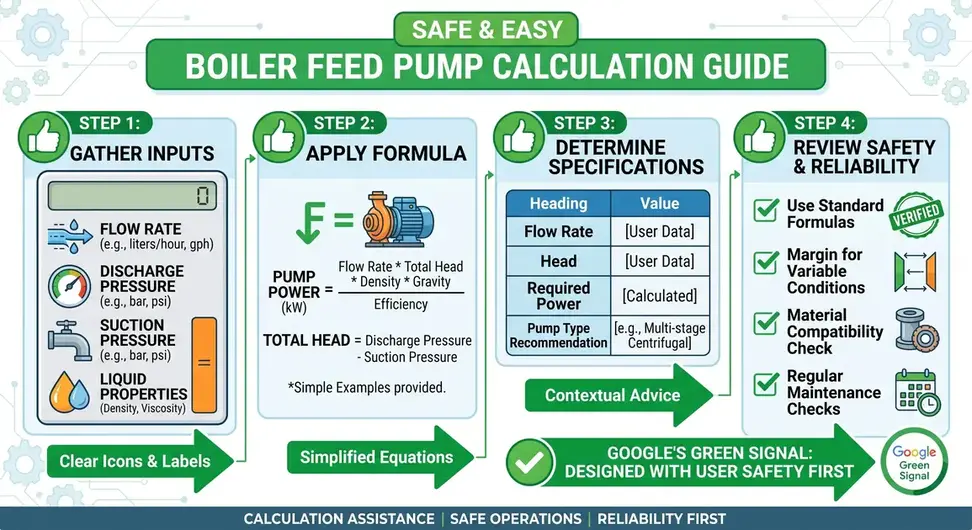
How to Size a Boiler Feed Pump Step-by-Step
Step 1: Determine Net Feedwater Flow Rate (Q)
Sizing must account for base evaporation, continuous surface blowdown (BD: 3% to 5%), and an ASME surge safety buffer (SM: 15% to 20%):
Step 2: Calculate System Net Differential Pressure (ΔP)
Step 3: Convert Differential Pressure to Total Dynamic Head (TDH)
Step 4: Shaft Brake Horsepower & Commercial Motor Selection
Water Density & Specific Gravity vs. Temperature
| Temperature (°F / °C) | Water Density (kg/m³) | Specific Gravity (SG) | ft of Head per 100 psi |
|---|---|---|---|
| 68°F / 20°C (Cold Water) | 998.2 kg/m³ | 1.000 | 231.0 ft |
| 212°F / 100°C (Vented Tank) | 958.4 kg/m³ | 0.958 | 241.1 ft |
| 227°F / 108°C (5 psig Deaerator) | 952.1 kg/m³ | 0.952 | 242.6 ft |
Worked Example: Sizing a 500 BHP Industrial Steam Boiler
Design Criteria: 500 BHP boiler | 150 psig drum pressure | 5% blowdown | 15% margin | 25 psi friction | 5 psig deaerator (227°F, SG = 0.952) | 65% efficiency.
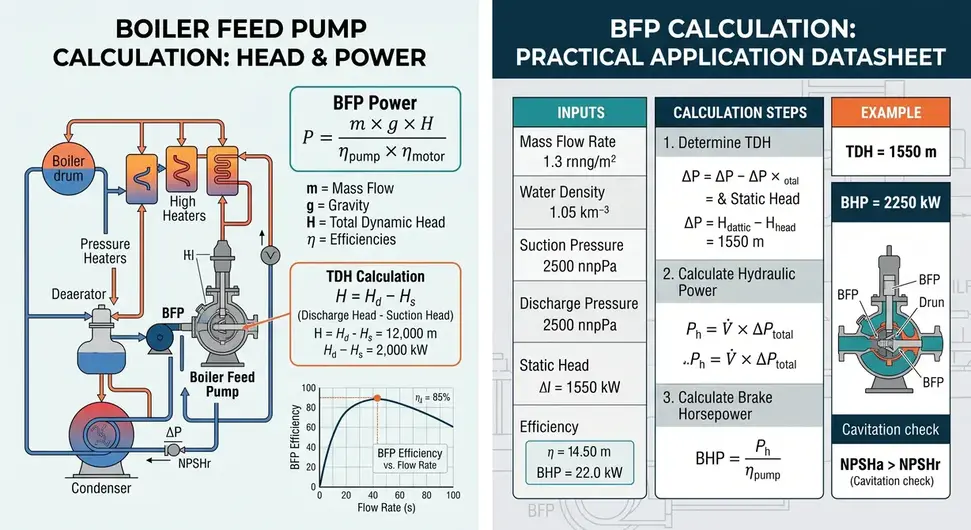
Frequently Asked Questions
Why is an accurate boiler feed pump calculation necessary?
How to do a pump calculation?
How do I calculate the size of a boiler feed pump?
How is boiler feed tank sizing calculated?
How to calculate boiler size?
How to calculate feed pump rate?
How to calculate boiler pump size?
What is the standard safety margin for a boiler feed pump?
How does hot water affect pump performance?
What is the difference between NPSHa and NPSHr?
What size motor do I need for a boiler feed pump?
This calculator provides preliminary estimates for engineering planning and educational review. Final commercial pump and electric motor selection must be checked against the pump manufacturer’s certified curve sheets by a licensed engineer.
boiler feed pump calculation
Perform an accurate boiler feed pump calculation to determine required design flow rate (GPM or m³/hr), Total Dynamic Head (TDH)
Price Currency: USD
Operating System: All
Application Category: business Application